


Hot Forgings
↵
Your Professional Hot Forgings Supplier
Guangway Machinery is a leading industry player in making mechanical components. We have a focus in manufacturing and custom and want to provide our clients with specialized needs in a number of industries. Our complete scope of services consists of forging, casting, CNC machining, and extrusions in copper, and it's all done to a high level and with a high level of precision. The company's forgings are divided into hot forgings and cold forgings. We select each material with consideration to its particular properties and application requirements.
-
![Hot-Forged Plow Shovel]() Hot-Forged Plow ShovelHot-Forged Plow Shovel: An Elite Farm Equipment For Performance & Durabilityread more
-
![Hot-Forged Plowshare]() Hot-Forged PlowshareHot-Forged Plowshare: Improved Farm Machinery for Max Efficiency & Longevityread more
-
![Hot-forged Auto Parts]() Hot-forged Auto PartsHot - forging vehicle parts are critical in the automotive industry. The parts are developed with a hot - forging process, in which pre - heating is conducted on metal billets at high heat before...read more
-
![Hot-forged Cylinder Joint]() Hot-forged Cylinder JointA hot-forged cylinder joint is a critical device in many industrial industries, more specifically in hydraulic as well as pneumatic machinery. The joint is fabricated in a manner that...read more
-
![Hot-forged U-shaped Crane Hook]() Hot-forged U-shaped Crane HookName: Hot - forging Crane Hook in shape of letter Uread more
Function: Specifically designed for lifting heavy loads in industrial structures, construction sites, manufacturing units, as well as... -
![Hot-forged Flanges]() Hot-forged FlangesHot - forging flanges are important piping system fittings that are highly regarded with excellent durability and high quality. The flanges are produced through a hot forging process that is a...read more
-
![Hot-forged Parts for Power Lines]() Hot-forged Parts for Power LinesHot - forging power line elements are essential in power distribution networks as well as power transmitting networks. The elements are produced in a hot - forging process that is involved in...read more
-
![Hot-forged Nut Plate]() Hot-forged Nut PlateHot - forging nut plates are a vital item in many industries as a workable, high-strength component. The nut plates are produced through a hot - forging process, a procedure that heat-treats the...read more
-
![Hot-forged Parts for Oil and Gas Industry]() Hot-forged Parts for Oil and Gas IndustryHigh-Strength Alloys: In gas as well as petroleum production, high-strength corrosive-resistant material requirements are in hot-forged parts.read more


Why Choose Us?
Quality Assurance
As an ISO 9001 certified company, we implement strict quality control measures at every stage of production. Each part undergoes a lot of checks during production to ensure it meets high standards.
OEM & ODM Available
We can design in 3D and provide detailed drawings using sophisticated design software to your requirements so that you get your finished item in the way you desire.
Advanced Equipment
Our state - of - the - art testing apparatus, such as spectrometers, metallographic testers, and hardness testers, are used to ensure the quality of materials and the accuracy of processing dimensions.
Our Services
We offer a warranty for our mechanical parts. We'll repair or replace them free of charge in case there's a problem with quality during warranty.Our after-sale service team can give you tips and guidance to extend your parts' lifespan.
Types of Hot Forgings
Hot-forged Flanges
Hot - forging flanges are important piping system fittings that are highly regarded with excellent durability and high quality. The flanges are produced through a hot forging process that is a metal forming procedure conducted at high temperatures.
Hot-forged Nut Plate
Hot - forging nut plates are a vital item in many industries as a workable, high-strength component. The nut plates are produced through a hot - forging process, a procedure that heat-treats the metal until workable. The metal is shaped with high pressures.


Hot-forged Auto Parts
Hot - forging vehicle parts are critical in the automotive industry. The parts are developed with a hot - forging process, in which pre - heating is conducted on metal billets at high heat before hammering into shape. The high - heat forging enhances mechanics in terms of toughness as well as resistance as well as in terms of strength.
Hot-forged Parts for Power Lines
Hot - forging power line elements are essential in power distribution networks as well as power transmitting networks. The elements are produced in a hot - forging process that is involved in heating metal until it is plastic in condition before shaping with high - pressure machines.
Specifications of Hot Forgings
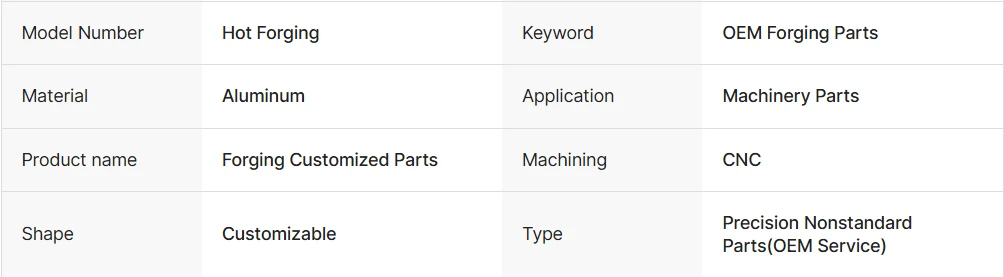
Features of Hot Forgings
Increased Strength: The refined grain structure and uniformity achieved through hot forging result in a stronger final product.
Improved Ductility: Hot forging enhances the material's ability to deform without fracturing, making it more durable.
Cost-Effective: While the initial setup for hot forging can be expensive, it is highly efficient for large-scale production runs, reducing the overall cost per part.
Customizability: Hot forging allows for the production of complex shapes and designs tailored to specific industrial needs.
High Production Rates: The process is suitable for mass production, making it ideal for industries requiring large parts.
Consistency: This type of forging ensures uniformity and consistency in the mechanical properties of the parts, which is essential for maintaining quality in industrial applications.
Customization Options
Shape:
Customizable
Material:
Customizable
Process:
Hot forging/Cold forging
Uses:
Various ranges
Manufacturing Process of Hot Forgings
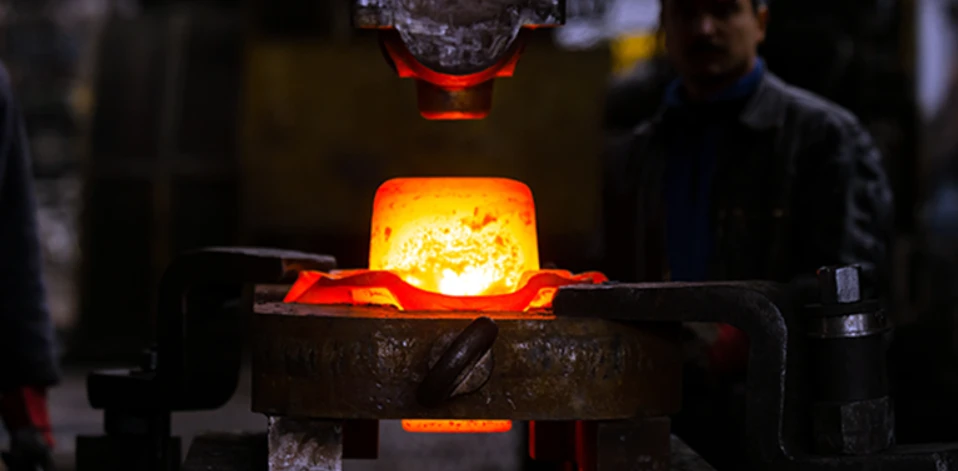
Hot forging occurs above the recrystallization temperature of a metal. The homologous temperature (TH) is used to distinguish it from the cold forging process (refer to hot forging vs cold forging).
TH = 0.6 x TS (TS: Melting temperature of the material – all figures in K)
If the process temperature is above TH, the process is defined as hot forging. This doesn't necessarily mean that the material needs to be heated. In low-melting metals (e.g. lead), recrystallization occurs at room temperature.
The characteristic effect of hot forming, is the significant material strength reduction (yield stress) at temperatures above TH. The forming component becomes a "doughy" consistency.
Recrystallization – The new formation of the metal crystalline lattice structure – is responsible for this. Through the degradation of the existing strain hardening (dislocation density) in the metal, the mobilization of dislocations (thermal activation) and the interchanging recovery and recrystallization processes occurring during and after the forging step, it is possible to achieve very high formability. Thus, hot forging is used when the goal is to achieve complex 3D geometries via forming. In addition, it enables the processing of difficult-to-form materials, which can be formed only with limitations when cold. Due to the strength reduction under hot forging conditions, the force and work demand of the processes can be lowered in comparison to cold forming.
The recrystallization is responsible, through the complete reformation of the microstructure, possibly multiple times, for the formation of a relatively fine-grained microstructure. It exhibits the optimal combination of strength and ductility. This circumstance qualifies hot forging as one of the most important manufacturing processes for the production of highly stressed safety components.
Certificate


Packaging & Delivery
|
Packaging |
Wooden Cases, Cartons, Palletization. |
|
Shipping |
By logistics; by shipping; by air. |
|
Payment |
Paypal, Western Union, T/T, L/C. |
FAQ
We're professional hot forgings manufacturers and suppliers in China, specialized in providing high quality customized service. We warmly welcome you to buy bulk hot forgings made in China here from our factory.
forged brackets, forged pulleys, Hot forged Auto Parts