


Forgings
Guangway Machinery:Your Professional Forgings Manufacturer!
Guangway Machinery is a leading industry player in making mechanical components. We have a focus in manufacturing and custom and want to provide our clients with specialized needs in a number of industries. Our complete scope of services consists of forging, casting, CNC machining, and extrusions in copper, and it's all done to a high level and with a high level of precision.
-
![Hot-Forged Plow Shovel]() Hot-Forged Plow ShovelHot-Forged Plow Shovel: An Elite Farm Equipment For Performance & Durabilityread more
Hot-Forged Plow ShovelHot-Forged Plow Shovel: An Elite Farm Equipment For Performance & Durabilityread more -
![Hot-Forged Plowshare]() Hot-Forged PlowshareHot-Forged Plowshare: Improved Farm Machinery for Max Efficiency & Longevityread more
Hot-Forged PlowshareHot-Forged Plowshare: Improved Farm Machinery for Max Efficiency & Longevityread more -
![Hot-forged Auto Parts]() Hot-forged Auto PartsHot - forging vehicle parts are critical in the automotive industry. The parts are developed with a hot - forging process, in which pre - heating is conducted on metal billets at high heat before...read more
Hot-forged Auto PartsHot - forging vehicle parts are critical in the automotive industry. The parts are developed with a hot - forging process, in which pre - heating is conducted on metal billets at high heat before...read more -
![Hot-forged Cylinder Joint]() Hot-forged Cylinder JointA hot-forged cylinder joint is a critical device in many industrial industries, more specifically in hydraulic as well as pneumatic machinery. The joint is fabricated in a manner that...read more
Hot-forged Cylinder JointA hot-forged cylinder joint is a critical device in many industrial industries, more specifically in hydraulic as well as pneumatic machinery. The joint is fabricated in a manner that...read more -
![Hot-forged U-shaped Crane Hook]() Hot-forged U-shaped Crane HookName: Hot - forging Crane Hook in shape of letter Uread more
Hot-forged U-shaped Crane HookName: Hot - forging Crane Hook in shape of letter Uread more
Function: Specifically designed for lifting heavy loads in industrial structures, construction sites, manufacturing units, as well as... -
![Hot-forged Flanges]() Hot-forged FlangesHot - forging flanges are important piping system fittings that are highly regarded with excellent durability and high quality. The flanges are produced through a hot forging process that is a...read more
Hot-forged FlangesHot - forging flanges are important piping system fittings that are highly regarded with excellent durability and high quality. The flanges are produced through a hot forging process that is a...read more -
![Hot-forged Parts for Power Lines]() Hot-forged Parts for Power LinesHot - forging power line elements are essential in power distribution networks as well as power transmitting networks. The elements are produced in a hot - forging process that is involved in...read more
Hot-forged Parts for Power LinesHot - forging power line elements are essential in power distribution networks as well as power transmitting networks. The elements are produced in a hot - forging process that is involved in...read more -
![Hot-forged Nut Plate]() Hot-forged Nut PlateHot - forging nut plates are a vital item in many industries as a workable, high-strength component. The nut plates are produced through a hot - forging process, a procedure that heat-treats the...read more
Hot-forged Nut PlateHot - forging nut plates are a vital item in many industries as a workable, high-strength component. The nut plates are produced through a hot - forging process, a procedure that heat-treats the...read more -
![Hot-forged Parts for Oil and Gas Industry]() Hot-forged Parts for Oil and Gas IndustryHigh-Strength Alloys: In gas as well as petroleum production, high-strength corrosive-resistant material requirements are in hot-forged parts.read more
Hot-forged Parts for Oil and Gas IndustryHigh-Strength Alloys: In gas as well as petroleum production, high-strength corrosive-resistant material requirements are in hot-forged parts.read more -
![Cold-forged Auto Parts]() Cold-forged Auto PartsCold - forging vehicle parts are essential in the automotive industry. The parts are produced in a cold forging operation that involved forming metal at room temperature or a slight above.read more
Cold-forged Auto PartsCold - forging vehicle parts are essential in the automotive industry. The parts are produced in a cold forging operation that involved forming metal at room temperature or a slight above.read more -
![Cold-forged Parts for Power Lines]() Cold-forged Parts for Power LinesCold - forging power line parts are those that are produced with cold forging processes. The parts are crucial in power line networks, i.e., supports, as well as connectors, and also fasteners.read more
Cold-forged Parts for Power LinesCold - forging power line parts are those that are produced with cold forging processes. The parts are crucial in power line networks, i.e., supports, as well as connectors, and also fasteners.read more -
![Cold-forged Electrical Fittings]() Cold-forged Electrical FittingsCold forging is a room temperature process. In electric fittings, high surface quality, high precision, as well as enhanced mechanical properties are obtained with this process.read more
Cold-forged Electrical FittingsCold forging is a room temperature process. In electric fittings, high surface quality, high precision, as well as enhanced mechanical properties are obtained with this process.read more


Why Choose Us
Quality Assurance
As an ISO 9001 certified company, we implement strict quality control measures at every stage of production. Our state - of - the - art testing apparatus, such as spectrometers, metallographic testers, and hardness testers, are used to ensure the quality of materials and the accuracy of processing dimensions.
Material Expertise
At Guangway Machinery, we understand that material selection has a huge impact on mechanical part performance and lifespan. This is why our workshop machines a huge variety of materials like carbon steel, alloy steel, stainless steel, brass, copper, tin bronze, and aluminum alloy. We select each material with consideration to its particular properties and application requirements.
Customization Design
We have a skilled set of engineers who can collaborate with you to design customized mechanical components. We can design in 3D and provide detailed drawings using sophisticated design software to your requirements so that you get your finished item in the way you desire.
Our Services
We offer a warranty for our mechanical parts. We'll repair or replace them free of charge in case there's a problem with quality during warranty.Our after-sale service team can give you tips and guidance to extend your parts' lifespan.
Advantages of Forgings
Exceptional Strength and Durability: Forgings are renowned for their unmatched strength, making them ideal for applications requiring robust components that can withstand high stress and loads.
Improved Grain Structure: Forgings showcase finer and more uniform grain structures, contributing to their enhanced mechanical properties and reliability.
Reduction of Porosity and Inclusions: The forging process minimizes internal defects such as porosity and inclusions, resulting in parts with improved structural integrity and performance.
Enhanced Structural Integrity: The forging process imparts a refined microstructure, strengthening the overall structural integrity of the parts and reducing the likelihood of cracks or fractures..
Consistency in Mechanical Properties: Forgings offer a consistent and predictable set of mechanical properties, ensuring reliability and uniform performance across various applications.
Fine Surface Finish: Forged surfaces often exhibit smoother finishes than other manufacturing methods, enhancing aesthetics and functionality.
Parameters
|
Product name |
Forgings |
|
Service |
OEM / ODM or Sample Production |
|
Process Technology |
Precision CNC Machining + Surface Treatment |
|
Available Material |
Zinc alloy , stainless steel, copper, aluminum alloy etc. |
|
Size |
Customized as customer's drawings |
|
Shape |
Customer Required |
|
Heat treatment |
Annealing,Solution,Normalizing,Tempering,Quenching,Induction hardening,Hardening and tempering |
|
Tolerance |
±0.02mm |
|
Surface Treatment |
Polishing, Plating, Machining, Anodizing, shot, sand blasting, zinc plated, oxide, galvanized etc. |
|
Testing |
Three coordinate measurement machine for testing.Testing Machine Digital Height Gauge, caliper,, projection machine, roughness tester, hardness tester and so on |
Application of Forgings


Aerospace: Forging is extensively used in the aerospace industry to manufacture various components such as landing gear, engine parts, and structural components. These parts need to withstand high stress and extreme conditions, and forging provides the required strength and durability.
Automotive: Forging is a crucial process in the manufacturing of automobiles. It is used to create a wide range of components, including gears, axles, steering parts, and suspension parts. These components require high strength and toughness, and forging ensures that they can withstand the rigors of everyday use.
Construction: Forging is used extensively in the construction industry to manufacture parts such as bolts, nuts, and other fasteners. These components need to be able to withstand high loads and stresses, and forging ensures that they are strong and durable.
Defense: Forging plays a crucial role in the defense industry, where it is used to manufacture various components for weapons and military equipment. These components need to be able to withstand extreme conditions and stresses, and forging provides the required strength and durability.
Medical: Forging is used in the medical industry to manufacture various surgical tools and implants. These components need to be precise and durable, and forging provides the required strength and accuracy.
Oil and Gas: Forging is used in the oil and gas industry to manufacture various components such as valves, fittings, and connectors. These components need to be able to withstand high pressure and extreme temperatures, and forging ensures that they are strong and durable.
Power Generation: Forging is used in the power generation industry to manufacture components such as turbines and generators. These components need to be able to withstand high stress and extreme conditions, and forging provides the required strength and durability.
Material of Forgings
Alloyed Steel
Alloyed steel is combined with various elements such as manganese, silicon, nickel, titanium, copper, chromium, tungsten, molybdenum, and aluminum in different proportions. These additional elements enhance the steel's basic properties, including hardness, corrosion resistance, strength, formability, weldability, and ductility.
Aluminum
Aluminum is classified as a soft metal because of its low melting point. Despite being lightweight and easily shaped, aluminum is strong and highly resistant to corrosion and rust.
Copper
Copper, similar to aluminum, is classified as a soft metal and is easily formable. During the forging process, copper is typically used in bar form. Forged copper benefits from an improved microstructure and maintains its mechanical properties.
Titanium
Titanium is a high strength, low density metal with exceptional corrosion resistance; it is ductile and has a high melting point. Parts produced from titanium have properties similar to those found in carbon steel forgings but are much lighter.
Brass
Brass is an alloy of copper and zinc, with its mechanical properties varying based on the amounts of zinc and other elements. This combination results in brass being harder yet softer than copper, with a lower melting point. Its excellent formability makes brass ideal for applications requiring exceptional thermal and electrical conductivity.
Nickel
Nickel forgings are ideal for high-temperature environments where severe conditions and wear resistance are crucial. The forging process shapes nickel into geometric forms that often require no further machining and enhances the metal's grain structure.
Forgings Process Steps
Die Design and Manufacturing
Modern forging processes use dies to enhance the accuracy, precision and speed of parts produced. Die design and manufacturing is the first step in the forging process. A good die can provide advantages such as better grain flow, good surface finish, less wastage, improved dimensional accuracy and consistent production quality.
Billet/Ingot Preparation
Billets or ingots with varying cross-sections serve as raw materials for the forging process. Depending on the product specifications, the required lengths of the appropriate cross-sections are cut and incorporated into the forging production line.
Heating
There’s no point beating on a metal that is cold. In this step, the metal is heated, typically in a furnace, to its forging temperature. The forging temperature for steel ranges from 850 to 1150 degrees Celsius, while the ideal forging temperature for aluminum is up to 500 degrees Celsius. The specific heating and soaking temperatures for the forging process are determined based on the type of metal being used.
Forging
The heated metal is moved to the die, where it is pressed into shape. Multiple passes through various dies may be necessary to achieve the final form. Additionally, the part may require reheating between presses.
Heat Treatment
Most components are subjected to heat treatment following forging to enhance specific mechanical properties, including strength and hardness. The heat treatment processes that are normally used are annealing, tempering, quenching, normalising, solution treatment and case hardening.
Cooling
Cooling presents an excellent opportunity to enhance properties such as strength and grain structure. By employing various cooling mechanisms and rates, the development of desirable characteristics in forged components can be promoted.
Finishing
The component may require finishing operations, such as machining, trimming and surface treatment, before it is fit for use. Additionally, properties like corrosion resistance and aesthetic appeal can be enhanced by applying specific coatings during this stage.
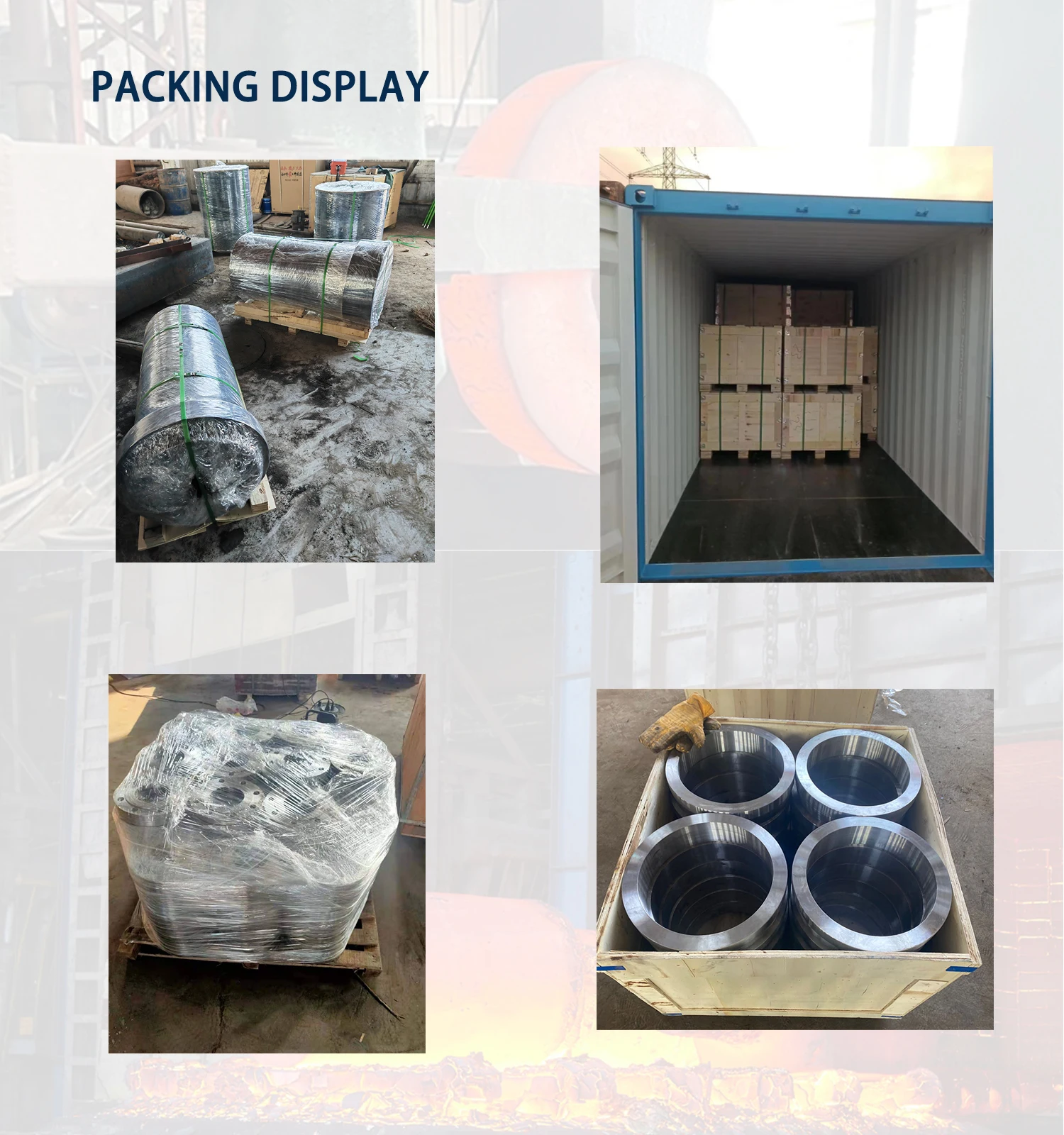
Packaging and Shipping
Inner Packaging
Strong & waterproof plastic big is packed inside, to keep the product in safe condition.Or as customer requests.
Outer Packaging
Multilayer wooden box with strong bandages, used for standard export package. Or customized as per customer's requirements.

Our Certificates


FAQ
We're professional forgings manufacturers and suppliers in China, specialized in providing high quality customized service. We warmly welcome you to buy bulk forgings made in China here from our factory.