


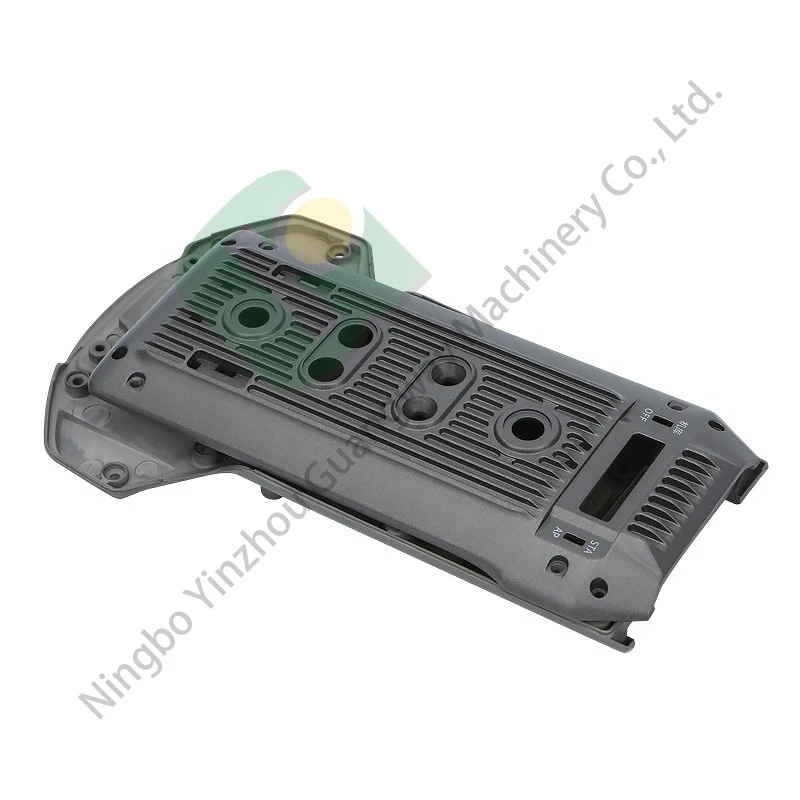


Material Selection
- Material Purities: The purities of the materials need to be rigorously controlled. The mechanical and physical characteristics of the die-casting are sensitive to impurities. Aerospace-grade impurities of copper, iron, and nickel should be nearly zero for the avoidance of galvanic corrosion and for the integrity of the components.
Die - Casting Process
- Mold Design: The magnesium alloy die-casting mold is precision-designed. The mold must be robust for the molten alloy's pressure injection and for the rapid cooling of the alloy. The mold cavities are precision-designed for the proper alloy filling with the objective of preventing the forming of the air pocket, the porosity, and the other kinds of the defects. High-grade computer-aided design (CAD) and computer-aided manufacturing (CAM) processes are employed for the mold design optimization.
- Injection Parameters: Well-managed injection rate, pressure, and temperature are important. The rate of injection should be adequate for the filling of the mold cavity before the alloy solidifies but should be such that it does not cause turbulence and the entrapping of air. The pressure of injection ranges between a few hundred and several thousand bar based upon the intricacy of the part. The molten alloy temperature is kept within a tight tolerance for the development of good fluidity and avoiding early solidification.
Heat Treatment
- Solution Treatment: The solution treatment of the magnesium alloy components follows the operation of the die-casting. Solution treatment includes heating the components at fixed temperatures for fixed times with the objective of solutionizing the alloying constituents into the phase-solid solution. Solution treatment improves the mechanical properties of the alloy by eliminating the built-up stresses and making the microstructure more consistent.
- Aging Treatment: Solution treatment done, treatment by the alloy by the aging done thereafter for the most part. Treatment at the fixed temperatures for the fixed duration helps the alloy constituents precipitate from the solution state of the solid into the state of the fine-dispersion form. The above treatment of the precipitation increases the magnesium alloy die-casting hardness and the strength again.
Quality Control
- Non - Destructive Test: Internal and surface deficiencies of the die - castings are identified by non - destructive testing techniques such as the X - ray inspection, the ultrasonic testing, and the dye penetrant inspection. Internal porosity, crack, and the other inclusions are revealed by the X - ray inspection while the subsurface deficiencies are best revealed by the ultrasonic testing. Surface crack is revealed by the dye penetrant inspection.
- Mechanical testing encompasses tensile testing, testing for hardness, and testing for the purpose of verifying that the magnesium alloy die-casting are within prescribed mechanical properties. The tensile testing identifies the material's tensile ultimate strength, the point of yielding, and the elongation. The ability of the material to withstand wear and tear and indentations are established by the testing for hardness. The testing for the ability of the component for withstanding load repeatedly over the duration of prolonged periods of times are determined by the testing for fatigue.
Surface Treatment
- Anodizing: The surface treats the majority of the surface of the aerospace industry with magnesium alloy die-casting by the use of the anodizing. It creates the surface oxide that enhances the alloy surface with enhanced corrosion resistance and the paint basis or the final coating. The parts are electroformed with the oxide film by the operation of the anodizing while they are dipped into the electro lytic solution.
- Coating: The material surface that has been anodizing can be treated with specially tailored coatings that enhance the thermal insulation, wear-resistance, and the anti-corrosion of the die-casting. The most appropriate types of the above requirements are organic coatings, ceramic coatings, or composite coatings for the specific needs of the aerospace industry.
Hot Tags: magnesium alloy die castings for aerospace components, China magnesium alloy die castings for aerospace components manufacturers, suppliers, factory, Magnesium Alloy Castings for Heavy Machinery, Magnesium Alloy Die Castings for Automotive Parts, Magnesium Alloy Die Castings for Electronics, Magnesium Alloy Die Castings for Industrial Applications, Magnesium Alloy Castings for Precision Engineering, Magnesium Alloy Die Castings for Aerospace Components